Treatment

Treating Bunions

Choose a preferred language


Although a bunion won't go away, wearing shoes that fit correctly will often relieve the pain. Padding the bunion and icing it may also help. Bunions that remain painful may need surgery.


Shoes

To relieve a bunion, you don't have to buy shoes that are out of fashion. But follow these tips:

  • Shop for shoes late in the day. This is when your feet are the largest.
  • Have both feet measured. Fit shoes to your larger foot.
  • Look for shoes that have the same shape as your foot but are slightly wider across the toes.
  • Choose low-heeled shoes.
  • Always try shoes on. Stand up and walk around. If the shoes aren't comfortable, don't buy them.
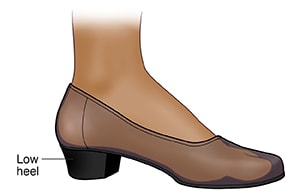
Side view of woman’s foot in low-heeled shoe.

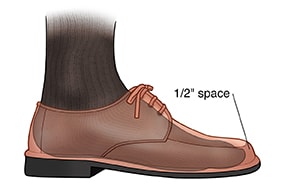
Side view of man’s foot in lace-up shoe, showing half an inch of space at end of shoe.


Ice massage

To help relieve a painful bunion, put an ice cube in a plastic bag. Rub the ice on the bunion for 5 minutes. Repeat 2 or 3 times a day.


Pads

You may want to put a bunion-shield type of pad over the bunion to cushion it. You can buy bunion pads at most drugstores. Also, you can use toe spacers or other inserts in your shoe to help decrease the pain from a bunion.


Surgery

If wearing wider shoes and padding the bunion does not relieve the pain, your doctor may suggest surgery. During surgery, the bunion is shaved away and the bones are put back in a straight line.

Online Medical Reviewer: Louise Cunningham RN BSN

Online Medical Reviewer: Raymond Turley Jr PA-C

Online Medical Reviewer: Thomas N Joseph MD

Date Last Reviewed: 09/01/2025

© 2000-2026 The StayWell Company, LLC. All rights reserved. This information is not intended as a substitute for professional medical care. Always follow your healthcare professional's instructions.



Find a Provider

View Our Directory

Find a Location

View Our Practices
Related Articles
Read article
Orthopedics
Kneecap Surgery: Removing Damaged Cartilage

Surgery may be used when pain severely limits your activities. Or it may be done when a rehab program or other nonsurgical treatments just are not helping enough. Some procedures may be done using arthroscopy. This method uses tiny incisions and special instruments to look and work inside the knee joint. Other procedures need open surgery.

Read article
Orthopedics
Treating Ankle Fractures

Treatment depends on where and how badly your ankle has been broken. A cast may be used to hold the bone in position for healing.

Read article
Orthopedics
Foot Surgery: Curled Fifth Toe

A curled fifth toe is most often inherited. When the fifth toe curls inward, it moves under the next toe. Then the nail of the curled toe starts to face outward. As a result, you may bear weight on the side of your toe instead of the bottom. This can cause corns and painful nails. There are many nonsurgical treatments available. But if these are not effective, surgery is a choice.

Read article
Orthopedics
Treating Hand Fractures

A fractured bone starts to heal right away. But a treatment called reduction may help you heal better. Reduction is a process that repositions your bones.