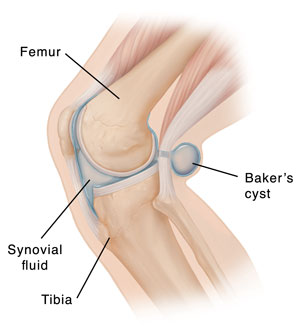
A Baker cyst (popliteal cyst) is a fluid-filled sac that forms behind the knee.
Types of treatment
You likely won’t need any treatment if you don’t have any symptoms from your Baker cyst. Some Baker cysts go away without any treatment. If your cyst starts causing symptoms, you might need treatment at that time.
If you do have symptoms, you may be treated depending on the cause of your cyst. For example, you may need medicine for rheumatoid arthritis.
Other treatments for a Baker cyst can include:
-
Over-the-counter pain medicines
-
Arthrocentesis, where a needle is used to remove extra fluid from the joint space (but not directly from the cyst)
-
Steroid injection into the joint to reduce cyst size
-
Aspiration of the cyst and injection of steroids
-
Surgery to remove the cyst
Possible complications of a Baker cyst
In rare cases, a Baker cyst may cause complications. The cyst may get larger, which may cause redness and swelling. The cyst may also rupture, causing warmth, redness, and pain in your calf.
The symptoms may be the same as a blood clot in the veins of the legs. Your healthcare provider may need imaging tests of your leg to make sure you don’t have a clot. Rupture can also lead to its own complications, such as:
-
Trapping of a tibial nerve. This causes calf pain and numbness behind the leg. It can be treated with arthrocentesis and steroid injections.
-
Blockage of the popliteal artery. This causes pain and lack of blood flow to the leg. It can be treated with arthrocentesis and steroid injections or surgery.
-
Compartment syndrome. This causes intense pain and problems moving the foot or toes. It's the result of pressure building in the muscles, causing blood flow to decrease. Compartment syndrome is a medical emergency that requires immediate surgery. It can lead to permanent muscle damage if not treated right away.
When to call the healthcare provider
If your cyst starts causing mild symptoms, plan to see your healthcare provider soon. Seek medical care right away if you have symptoms such as redness and swelling of your leg, or numbness and discoloration of the foot. These symptoms may mean your Baker cyst has ruptured and may be causing other, more serious problems.
Online Medical Reviewer: Rahul Banerjee MD
Online Medical Reviewer: Raymond Turley Jr PA-C
Online Medical Reviewer: Rita Sather RN
Date Last Reviewed: 10/01/2024
© 2000-2026 The StayWell Company, LLC. All rights reserved. This information is not intended as a substitute for professional medical care. Always follow your healthcare professional's instructions.