Definition

Anatomy of the Male Abdomen and Groin

Choose a preferred language

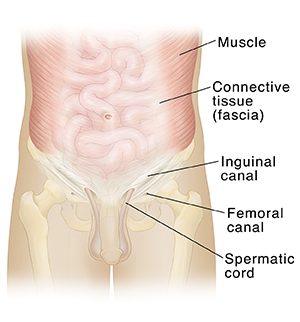
The belly (abdomen) is the largest space (cavity) in the body. It lies between the chest and the pelvis, holding many of the body’s organs. These include the liver, stomach, and intestines.

The groin is the area in the body where the upper thighs meet the lowest part of the abdomen. Normally, the abdomen and groin are kept separate by a wall of muscle and tissue. The only openings in the wall are small tunnels called the inguinal and femoral canals. These allow nerves, blood vessels, and other structures to pass between these 2 areas.
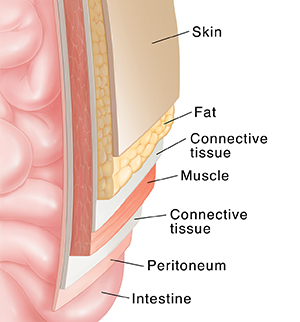
Cross section of abdominal wall over intestine showing layers: skin, fat, connective tissue, muscle, connective tissue, and peritoneum.


The abdomen and groin

  • Muscles. These are soft tissues. They enclose the intestines and other organs in the abdomen.

  • Connective tissue. These help bind the muscles together.

  • Inguinal canal. This tunnel in the groin is formed by layers of muscle and other tissues in the wall of the abdomen.

  • Femoral canal. This tunnel in the wall of the abdomen allows blood vessels and nerves to pass through the groin into the leg.

  • Spermatic cord. This passes through the inguinal canal and connects to the testicle.
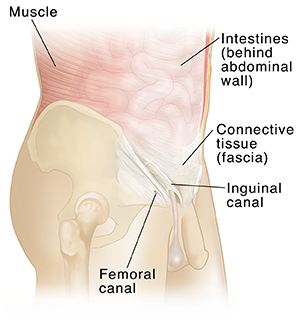
Side view of male torso showing abdominal muscles and intestines. Umbilical ring and internal inguinal ring are visible.Front view of male body showing muscles of abdomen and intestines.

Online Medical Reviewer: Jen Lehrer MD

Online Medical Reviewer: Raymond Kent Turley BSN MSN RN

Online Medical Reviewer: Rita Sather RN

Date Last Reviewed: 02/01/2025

© 2000-2026 The StayWell Company, LLC. All rights reserved. This information is not intended as a substitute for professional medical care. Always follow your healthcare professional's instructions.



Find a Provider

View Our Directory

Find a Location

View Our Practices
Related Articles
Read article
Digestive Health
Anatomy of the Anus

The anus is the last part of the digestive tract. Learn more about its anatomy, including where anal cancer is likely to start.

Read article
Digestive Health
Colostomy: Caring for Your Stoma

You need to take care of your stoma and the skin around it (peristomal skin). This helps prevent skin problems and odor.

Read article
Digestive Health
Discharge Instructions: Caring for Your T-Tube

You have been discharged with a T-tube, which is shaped like the letter T. It is put in place after bile duct surgery to drain bile while the duct is healing. The T-tube will be left in place for up to several weeks. Here's what you can do at home to aid your recovery.

Read article
Digestive Health
Ileostomy: Dealing with a Food Blockage

After an ileostomy, it may be harder to digest foods that are high in fiber. Eaten in large amounts, these foods can clump together and cause a blockage. Learn about the signs of a blockage and what to do if you have one.