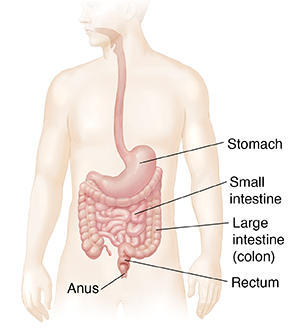
When you eat, food enters your digestive tract. This is a series of organs that form a pathway from your mouth to your anus. As food moves down this pathway, it is processed and changed to waste. The nutrients are absorbed in the body. After food is changed to waste, it is pushed out of your body in a bowel movement.
-
The stomach breaks down food into a liquid mixture.
-
The small intestine absorbs nutrients from the liquid mixture. What remains is liquid waste.
-
The large intestine (colon) absorbs water from the liquid waste, converting it into solid waste (stool).
-
Nerves along your digestive tract tell your muscles how fast to contract.
-
Muscles in the intestines contract to move food and waste through the digestive tract.
-
The rectum stores stool until a bowel movement happens.
-
The anus is the opening where stool leaves the body.
Online Medical Reviewer: Diane Horowitz MD
Online Medical Reviewer: Louise Cunningham RN BSN
Online Medical Reviewer: Paula Goode RN BSN MSN
Date Last Reviewed: 04/01/2025
© 2000-2026 The StayWell Company, LLC. All rights reserved. This information is not intended as a substitute for professional medical care. Always follow your healthcare professional's instructions.