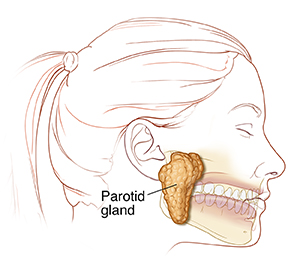
Parotid duct obstruction is when part of your parotid duct becomes blocked. The parotid ducts are 2 small tubes that lead from the parotid glands. These glands make saliva and send it into your mouth. When the parotid ducts are blocked, saliva can’t flow normally.
Salivary gland stones can cause blockages. Your risk for a stone may increase if you:
-
Don't drink enough fluids (dehydration).
-
Take certain medicines (anticholinergics, diuretics).
-
Have had an injury.
-
Smoke.
Types of treatment
You may start with treatments such as:
-
Drinking more water.
-
Putting moist heat on the area.
-
Massaging the gland and duct.
-
Sucking on tart or sour candies to cause saliva to flow.
-
Using nonsteroidal anti-inflammatory drugs (NSAIDs).
-
Stopping use of any medicines that lower the amount of saliva you make, if possible.
Many symptoms go away quickly with these types of treatments. If your symptoms don’t get better, you may need treatments such as:
-
Lithotripsy. This treatment uses shock waves to break up the stone. Laser lithotripsy is offered in some parts of the United States. It is an alternative treatment to extracorporeal lithotripsy. Extracorporeal lithotripsy is not approved by the U.S. Food and Drug Administration (FDA) to treat salivary stones.
-
Sialendoscopy with wire basket retrieval. During this procedure, your doctor puts a small lighted rod called an endoscope into the parotid duct. The endoscope helps your doctor see the stone. They may then use a wire basket to remove the stone through the duct. This procedure is used more often if a person has stones that keep coming back or if other treatments don't work.
-
Open surgery. This may include taking out part of the parotid gland and part of the duct. Or a cut may be made to get to the stone if other methods don’t work.
Your parotid gland should work like normal after the blockage is removed.
Possible complications of parotid duct obstruction
Sometimes obstruction of the duct also leads to infection of the gland and duct. This is more common in older adults. If you have an infection, you may have a fever and pain that gets worse. You may need treatment with antibiotics.
Most of the time, this kind of infection goes away with antibiotics. In other cases, a more severe infection may happen. You may have an infection of the deep layers of the skin. This can lead to a pus-filled infection (abscess) in your gland or neck. If your symptoms don’t get better, you may need to see an ear, nose, and throat doctor (ENT or otolaryngologist).
When to contact your doctor
Contact your doctor or get medical care right away if you have:
-
A fever of 100.4°F (38.0°C) or higher, or as directed by your doctor.
-
Pain that gets worse.
-
Any swelling that is getting worse or not getting better.
-
Pain in new areas of your head or neck.
Online Medical Reviewer: Jessica Gotwals RN BSN MPH
Online Medical Reviewer: Rita Sather RN
Online Medical Reviewer: Sumana Jothi MD
Date Last Reviewed: 08/01/2025
© 2000-2026 The StayWell Company, LLC. All rights reserved. This information is not intended as a substitute for professional medical care. Always follow your healthcare professional's instructions.