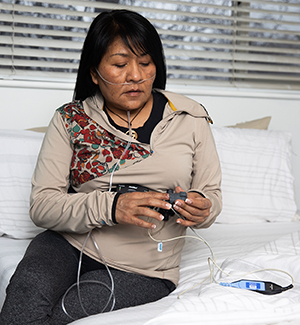
A home sleep apnea study tracks and records body functions while you’re asleep in your own bed. The results of the study will help diagnose sleep apnea and plan your treatment. Not every person is a candidate for home sleep apnea studies. Your doctor will tell you whether a sleep apnea study at home or at a sleep clinic is best for you.
How a home sleep apnea study works
During a sleep study, sensors attached to your body measure things, such as your breathing, oxygen level, and other body functions. You will be shown how to attach the sensors to your body. You may also have help from a technician. At bedtime you plug the sensors into a small computer and turn it on. In the morning, you will remove the sensors and return the computer so the results can be studied. A doctor who specializes in sleep disorders will review the results. They will then send the information to your doctor. Your doctor will discuss the results with you.
Tips
You’ll be given directions for how to set up the sensors and the computer. Doing so will be simple. For best results:
-
Go through the directions during the day so you’ll be ready to use the equipment at bedtime.
-
Stick to your normal routine. Ask your doctor if you should do anything differently the night of the study. If you normally use caffeine or alcohol, or take sleep medicine before bed, be sure to let your doctor know.
-
If you get up during the night, reconnect the sensors to the computer or to yourself correctly.
-
Get as many hours of sleep as you can.
Getting the results
The results of your sleep study need to be scored and interpreted. Once this is done, your doctor will discuss the findings with you. The sleep study results will show whether you have sleep apnea. This is when your breathing stops temporarily many times during the night, awakening you briefly. It can also tell how severe the sleep apnea is. The findings help your doctor know which treatments may be the right ones for you.
Online Medical Reviewer: Daphne Pierce-Smith RN MSN
Online Medical Reviewer: Mahammad Juber MD
Online Medical Reviewer: Rita Sather RN
Date Last Reviewed: 05/01/2025
© 2000-2026 The StayWell Company, LLC. All rights reserved. This information is not intended as a substitute for professional medical care. Always follow your healthcare professional's instructions.