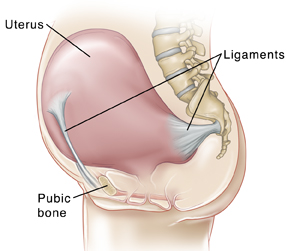
You are well into your pregnancy and are having pain and pressure in your pelvic area. This is your lower belly (abdomen). Mild pelvic pressure or heaviness is very common in the later stages of a healthy pregnancy. It is due to the growing uterus (womb). Although the exact cause of your pain is not certain, it doesn't seem to be dangerous. It may be due to ligaments in your belly stretching to support your uterus as it grows. The weight of your baby may also be causing pressure and pain. Pain can be caused by the bones of your pelvis shifting as your body makes room for the baby to pass through. This is known as symphysis pubis dysfunction (SPD). SPD can cause quite a bit of pain and discomfort as the due date nears.
Home care
Here are general care guidelines:
-
Don't do any strenuous activities or stand for a long time. Bed rest is not needed unless your healthcare provider has advised it.
-
Exercise for 30 minutes all or most days of the week. This will promote muscle tone, strength, and endurance. Ask your provider what exercises to do and to not do.
-
Sit in a warm (not hot) bath. This helps relax tight, painful muscles.
-
Sleep on your side with a pillow between your legs. This helps align your pelvis.
-
Eat frequent, light meals. Choose foods that are easy to digest.
-
Ask your healthcare provider if a pregnancy support belt could help you.
-
If told to by your healthcare provider, take an over-the-counter medicine, such as acetaminophen, to ease pain. Follow instructions carefully for how much to take and how often to take it. Don't take aspirin or nonsteroidal anti-inflammatory drugs (NSAIDs) such as ibuprofen unless your provider tells you to do so.
Follow-up care
Follow up with your healthcare provider, or as advised.
When to get medical care
Call your healthcare provider right away if any of these occur:
-
Belly pain that is sudden or that slowly gets worse
-
Fainting, dizziness, or weakness when standing
-
Any vaginal bleeding
-
Fluid leaking from the vagina
-
Baby is moving less
-
Repeated vomiting or diarrhea
-
Pain that seems to settle in 1 area, especially the lower right belly
-
Blood in vomit or bowel movements (dark red or black color)
-
Fever of 100.4°F (38°C) or higher, or as advised by your provider
Online Medical Reviewer: Donna Freeborn PhD CNM FNP
Online Medical Reviewer: Heather Trevino
Online Medical Reviewer: Irina Burd MD PhD
Date Last Reviewed: 12/01/2022
© 2000-2026 The StayWell Company, LLC. All rights reserved. This information is not intended as a substitute for professional medical care. Always follow your healthcare professional's instructions.