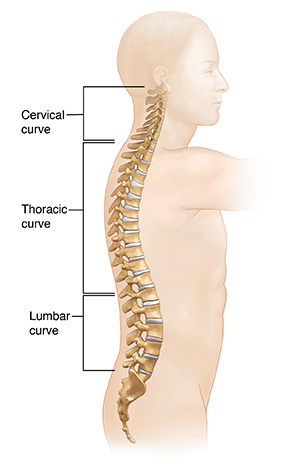
A healthy back lets you bend and stretch without pain. The spine has 3 natural curves. These keep your body balanced. Strong, flexible muscles support your spine. Soft, cushioning disks separate the hard bones of your spine. The disks let your spine bend and move.
The parts of the spine
-
The vertebrae are the 33 bones that form the spinal column. Only the top 24 bones are moveable. The rest are fused. Those make up the sacrum and coccyx.
-
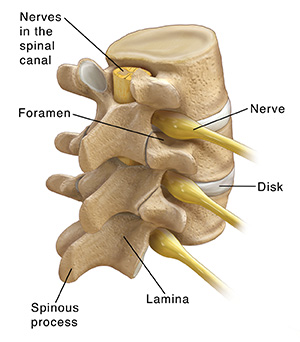
The spinous process is the part of each vertebra you can feel through your skin.
-
Each of these bones has a central hole that runs top to bottom. Together, these holes form a tunnel called the spinal canal.
-
The lamina of each vertebra forms the back of the spinal canal.
-
Running through the canal are nerves. They are attached in a bundle called the spinal cord for most of the canal.
-
A foramen is a small opening where a spinal nerve root leaves the spinal canal.
-
Disks serve as cushions between vertebrae. A disk’s soft center absorbs shock during movement.
The supporting muscles
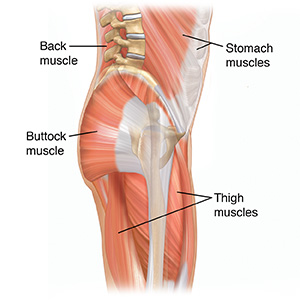
Strong, flexible muscles help maintain your 3 natural curves. They hold your spine in correct alignment. This helps support your upper body. Strong core muscles help take the strain off your back. These include the stomach, buttock, and thigh muscles.
Online Medical Reviewer: Anne Fetterman RN BSN
Online Medical Reviewer: Joseph Campellone MD
Online Medical Reviewer: Raymond Kent Turley BSN MSN RN
Date Last Reviewed: 04/01/2024
© 2000-2026 The StayWell Company, LLC. All rights reserved. This information is not intended as a substitute for professional medical care. Always follow your healthcare professional's instructions.