Definition

Know Your Neck: The Cervical Spine

Choose a preferred language

By learning about the parts of the neck, you can better understand your neck problem. The bones of the neck are called cervical vertebrae, commonly identified as C1 through C7. Together, they form a bony column called the spine. Vertebrae also protect the spinal cord, a pathway for messages to reach the brain. Surrounding the spine are soft tissues, such as muscles, tendons, and nerves.
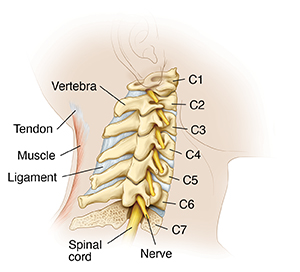
Side view of cervical spine with lowest vertebra in cross section to show spinal cord.


Flexibility is key

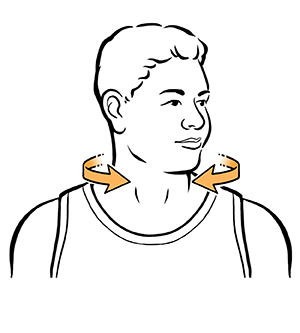
For the neck to function normally, it has to be flexible enough to move without discomfort. A healthy neck can move easily in six different directions.
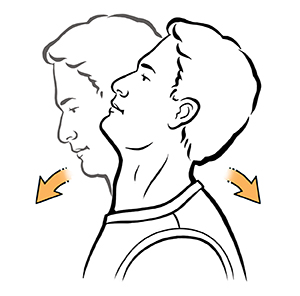
Side view of man tilting head forward and backward.

Front view of man rotating head from side to side.

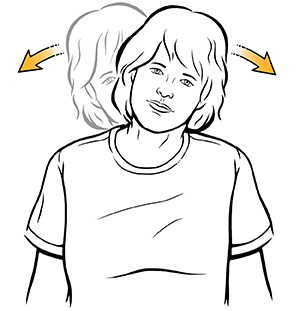
Front view of woman tilting head towards one shoulder, then the other.

Online Medical Reviewer: Joseph, Thomas N., MD

Online Medical Reviewer: Walton-Ziegler, Olivia, MS, PA-C

Date Last Reviewed: 08/01/2023

© 2000-2026 The StayWell Company, LLC. All rights reserved. This information is not intended as a substitute for professional medical care. Always follow your healthcare professional's instructions.



Find a Provider

View Our Directory

Find a Location

View Our Practices
Related Articles
Read article
Orthopedics
Quadruped Arm-Reach Exercise

Try these reach and hold exercises to stretch your neck and upper back.

Read article
Orthopedics
What Are Mallet, Hammer, and Claw Toes?

Mallet, hammer, and claw toes are among the most common foot problems. They are often caused by wearing shoes that are too short or heels that are too high.

Read article
Orthopedics
Understanding Bones

A typical bone in your body contains three types of tissue: a hard outer tissue, a sponge-like inner tissue, and smooth tissue at the ends.

Read article
Orthopedics
Common Kneecap (Patella) Problems

If the kneecap is “off track” even a bit (a tracking problem), it can cause uneven pressure on the back of the kneecap. This can cause pain and trouble with movements, such as walking and going down stairs. Below are some common causes of kneecap pain.