Management

After Hip Replacement: Home Safety

Choose a preferred language

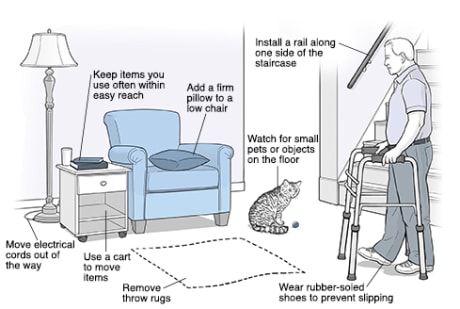
Becoming more aware of hazards in your home can help make your recovery safer. You might want to have furniture rearranged so it's easier to get around. Consider aids in the bathroom, such as a hand-held shower head and a raised toilet seat, to help you stay safe. Don't forget to watch out for hazards like wet floors, loose or worn rugs, electrical cords, or uneven surfaces.
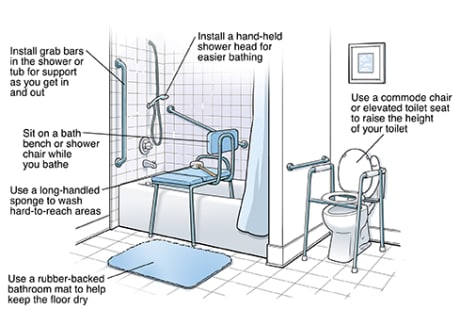
Safety measures to take in the bathroom.

Safety measures to take in your living area.

Online Medical Reviewer: L Renee Watson MSN RN

Online Medical Reviewer: Thomas N Joseph MD

Date Last Reviewed: 07/01/2023

© 2000-2026 The StayWell Company, LLC. All rights reserved. This information is not intended as a substitute for professional medical care. Always follow your healthcare professional's instructions.



Find a Provider

View Our Directory

Find a Location

View Our Practices
Related Articles
Read article
Orthopedics
After Total Hip Replacement: Returning to Activity

After a total hip replacement, you'll continue to recover at home and find yourself returning to your daily routine. The key to becoming active again is to stick with your recovery program. Read more for tips on getting back to an active lifestyle.

Read article
Orthopedics
Conditioning Before Knee Replacement

Conditioning your body BEFORE knee replacement can help speed your recovery. Daily exercise helps strengthen muscles that support the knee joint.

Read article
Orthopedics
Quadriceps, Isometric (Strength)

Follow the step-by-step directions for this knee exercise.

Read article
Orthopedics
Knee Immobilizer

A knee immobilizer is a type of brace used to provide support and limit movement of the knee. Here's what you need to know as you heal at home.