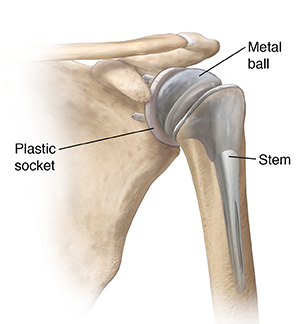
During shoulder replacement surgery, all or part of your shoulder is replaced with an artificial joint (prosthesis). The prosthesis replaces the rough, worn parts of your shoulder with smooth metal and plastic parts. You have many choices for different prostheses. Your surgeon will discuss the best one for you. Common causes of problems that may need shoulder replacement include osteoarthritis, rheumatoid arthritis, and various injuries.
Before your surgery
You will most likely arrive at the hospital on the morning of the surgery. Tell your doctor about any medicines you take. This includes over-the-counter medicines, vitamins, and supplements.
Be sure to follow all of your doctor's directions on getting ready for surgery:
-
Follow any directions you are given for taking medicines or for not eating or drinking before surgery.
-
At the hospital, the staff will check your temperature, pulse, breathing, and blood pressure.
-
An IV (intravenous) line will be started. This will provide fluids and medicines you need during surgery.
The surgical procedure
You will be taken to the operating room when the surgical team is ready. There you will be given anesthesia to help you sleep through surgery. Your surgeon may replace just the ball (partial replacement). Or they will replace both the ball and the socket (total replacement). The surgeon makes a cut (incision) about 6 inches long from your collarbone to your arm. When the new joint is in place, your surgeon closes the incision with surgical staples or stitches (sutures).
After your surgery
After surgery, you'll be sent to the recovery room. When you are fully awake, you'll be moved to your room. You can go home after surgery in some cases. The nurses will give you medicines to ease your pain. Your care team will help you get up and moving. You may also have physical therapy after surgery.
You may need to wear an arm sling for a few weeks. You will likely have a specific rehabilitation or physical therapy plan to get the best healing after surgery.
When to contact your doctor
After you return home, contact your doctor if you have:
-
Pain that gets worse even with your pain medicine.
-
Unusual redness, heat, or drainage at the incision site.
-
A fever of
100.4 °F (38 °C) or higher, or as directed by your doctor. -
Chills.
Featured in
Online Medical Reviewer: Stacey Wojcik MBA BSN RN
Online Medical Reviewer: Thomas N Joseph MD
Date Last Reviewed: 06/01/2025
© 2000-2026 The StayWell Company, LLC. All rights reserved. This information is not intended as a substitute for professional medical care. Always follow your healthcare professional's instructions.