Basal joint arthritis affects the joint at the base of your thumb. Your treatment will depend on how bad the pain is, the type of arthritis you have in this joint, and how worn the joint is.
Nonsurgical treatment
If arthritis is diagnosed early, it often responds to treatment without surgery. Your healthcare provider may put a splint on your thumb for 3 to 6 weeks. This limits movement and helps reduce the inflammation. Splints can be worn at night and off-and-on during the day. You may get relief by putting an ice pack on the thumb often. You may be given a pain medicine, such as acetaminophen. You may also be given oral anti-inflammatory medicine, such as ibuprofen or aspirin. Your provider may give you prescription medicines for certain causes of your arthritis. If your symptoms don’t get better, your provider may give you injections of an anti-inflammatory medicine, such as cortisone right into the joint. Or they may give you a different injected medicine.
Surgical treatment
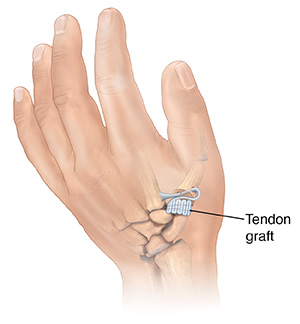
If nonsurgical treatment doesn’t ease the pain and stiffness, or if arthritis has destroyed the joint, your healthcare provider may advise surgery. Surgery is a choice only after you've tried all or most nonsurgical choices. In a tendon graft surgery, the surgeon removes the diseased joint. Then the joint is rebuilt. They usually use a piece of tendon (graft) taken from your arm or wrist. Your arm is numbed so you don’t feel pain during surgery. You can usually go home the day of surgery. Other surgeries include:
-
Rebuilding a ligament
-
Complete joint replacement
-
Bone fusion
Talk with your surgeon about the treatment that's best for you and how much relief you can expect.
Your recovery after surgery
First your hand will be wrapped in a dressing. Then you’ll have a cast or a splint on your thumb for
Online Medical Reviewer: Diane Horowitz MD
Online Medical Reviewer: Marianne Fraser MSN RN
Online Medical Reviewer: Raymond Kent Turley BSN MSN RN
Date Last Reviewed: 03/01/2024
© 2000-2026 The StayWell Company, LLC. All rights reserved. This information is not intended as a substitute for professional medical care. Always follow your healthcare professional's instructions.