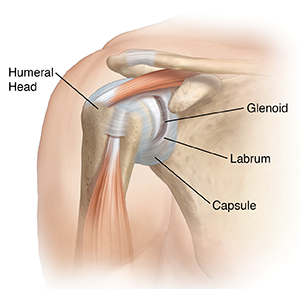
The shoulder is the most mobile joint in your body. The ball (or “head”) of the arm bone (humerus) rests in a shallow socket called the glenoid. To help make the socket deeper, the outer rim of the glenoid is ringed by tough, flexible tissue called the labrum. An injury to the labrum can result in a Bankart lesion.
What is a Bankart lesion?
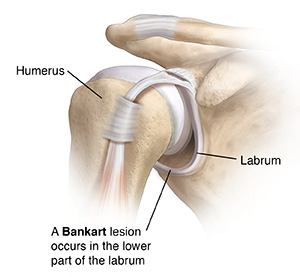
The shoulder joint is enclosed by a sheet of ligaments and other tough fibers called the capsule. During a shoulder dislocation, fibers in the capsule can pull on the labrum and cause it to tear. A Bankart lesion is the name for a tear that happens in the lower rim of the labrum. Once the labrum is torn, it’s much easier for the humerus to slip out of its socket. You may also have pain and feel as if your shoulder is slipping out of place.
Diagnosing a Bankart lesion
To diagnose the problem, your healthcare provider will examine your arm and shoulder. This includes moving your arm in certain directions to test for symptoms. Imaging tests, such as X-rays or an MRI, give your healthcare provider a detailed view of the tissues inside your shoulder joint.
Treating a Bankart lesion
Rest and anti-inflammatory medicines are often the first line of treatment. You may be given steroid medicine shots (injections). Physical therapy may also be prescribed to strengthen the muscles and stabilize the shoulder joint. If these treatments aren’t enough, your healthcare provider may recommend surgery to repair the labrum.
Online Medical Reviewer: L Renee Watson MSN RN
Online Medical Reviewer: Raymond Turley Jr PA-C
Online Medical Reviewer: Thomas N Joseph MD
Date Last Reviewed: 04/01/2024
© 2000-2026 The StayWell Company, LLC. All rights reserved. This information is not intended as a substitute for professional medical care. Always follow your healthcare professional's instructions.