The strength of bones is measured by their density. This means how thick the bone tissue is. High bone density means bones are less likely to break (fracture). If you're at risk for bone loss, your healthcare provider may refer you for bone density testing.
Bone density testing
Bone density testing is safe, quick, easy, and painless. It can find osteoporosis before a fracture happens. It can also measure how well treatment works. There are several types of tests that you may have. They include:
-
Central tests. These are used for screening and diagnosis. They measure density in the hip and spine. The main central test is a special X-ray called the DEXA scan (dual energy X-ray absorptiometry). The DEXA is the standard bone density test.
-
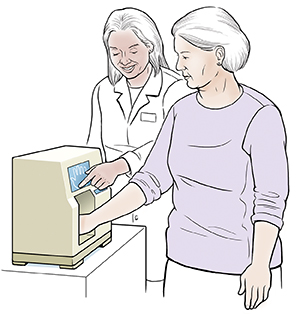
Peripheral tests. These are used for screening. They measure density in the finger, wrist, knee, shin, or heel. A common peripheral test is the quantitative ultrasound (QUS). But QUS screening is not as accurate as DEXA screening.
Who should be tested?
-
All postmenopausal women under age 65, with 1 or more risk factors in addition to menopause
-
All women age 65 and older
-
Postmenopausal women with fractures
-
Women who are thinking about treatment for osteoporosis
-
Women who have been on hormone therapy for a long time
-
Men or women with certain health conditions (such as diabetes) or who are taking certain medicines (such as glucocorticoids or prednisone) for a long time
Common testing sites on your body
Any bone can fracture. But with osteoporosis, some bones fracture more easily. These include bones in the spine, wrist, shoulder, and hip. That’s why bone density testing may be done at 1 or more of these sites on your body.
Understanding your results
Your test results may seem confusing at first. Ask your provider to explain. They will compare your bone mineral density (BMD) with the BMD of young, healthy bone. The result is called a T-score. Bones build tissue (remodel) at different rates. So a healthy T-score in the wrist doesn’t mean the spine is also healthy. That’s why more than 1 site on your body may be scanned.
Online Medical Reviewer: Raymond Turley Jr PA-C
Online Medical Reviewer: Stacey Wojcik MBA BSN RN
Online Medical Reviewer: Thomas N Joseph MD
Date Last Reviewed: 03/01/2024
© 2000-2026 The StayWell Company, LLC. All rights reserved. This information is not intended as a substitute for professional medical care. Always follow your healthcare professional's instructions.