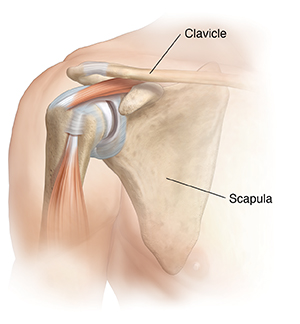
You have one long collarbone (clavicle) on top of each shoulder. The collarbone is attached to your shoulder blade (scapula). These bones hold your arms in place and help them move. Collarbone breaks (fractures) are very common, and are often due to a blow or fall. Shoulder blade fractures are much less common. Without treatment, either injury can lead to chronic shoulder problems.
Risk factors
The collarbones don't harden fully until about age 20. As a result, children and teens can easily fracture these bones. A baby's collarbone may fracture during birth. Shoulder blades rarely break. When they do, it's often the result of violent trauma, such as a car crash.
When to go to the emergency room (ER)
Get help right away if you suspect a fractured collarbone or shoulder blade. The symptoms of a fractured collarbone or shoulder blade may include:
-
Extreme pain when you move your arm
-
A shoulder that sags down and forward
-
A bump over the fracture site
-
A grinding feeling and extreme pain when you try to lift your arm
-
Bone sticking out (protruding) from skin, or "tenting" of skin at the fracture site
What to expect in the ER
Here's what will happen in the ER:
-
You'll be examined.
-
X-rays will be taken of your chest and shoulder.
-
You may be given medicine to reduce your pain.
-
A (CT) scan may be done. This test provides detailed images of your bones.
Treatment
Both types of fractures are often treated with an arm sling. This holds the bone in place and keeps it from moving during healing. You also may be instructed to do special exercises to help improve strength and range of motion in your shoulder. In some cases, surgery is advised to realign the fracture and hold it in place so that it can heal correctly.
Online Medical Reviewer: L Renee Watson MSN RN
Online Medical Reviewer: Raymond Turley Jr PA-C
Online Medical Reviewer: Thomas N Joseph MD
Date Last Reviewed: 09/01/2024
© 2000-2026 The StayWell Company, LLC. All rights reserved. This information is not intended as a substitute for professional medical care. Always follow your healthcare professional's instructions.