How do the kidneys work?
Your child's body takes nutrients from food and converts them into energy. After your child's body has taken the nutrients it needs, waste products are left behind. They are left in the bowel and in the blood.
The kidneys and urinary system keep water and chemicals, such as potassium and sodium, in balance. They do this by removing a type of waste called urea from the blood. Urea is made when protein foods such as meat, poultry, and certain vegetables are broken down in the body. Urea is carried in the bloodstream to the kidneys.
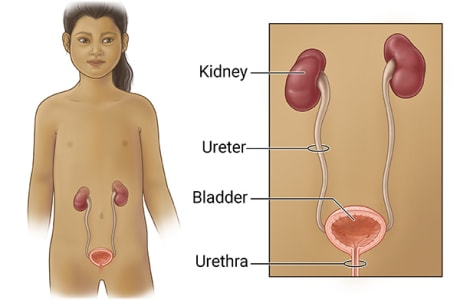
The kidneys are a pair of purplish-brown organs. They are located below the ribs toward the middle of the back. They:
- Remove liquid waste from the blood in the form of urine.
- Keep the correct balance of salts (electrolytes) and other substances in the blood.
- Make erythropoietin, a hormone that helps red blood cells form.
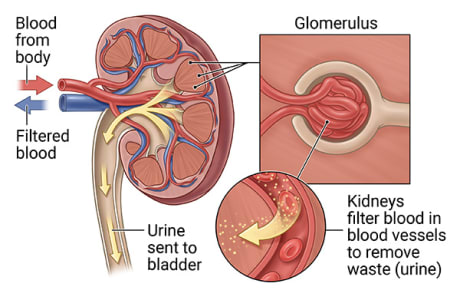
The kidneys remove urea from the blood through tiny filtering units called nephrons. Each kidney has about one million nephrons. They are in the medulla and the cortex. Each nephron is made up of a ball formed of small blood capillaries (a glomerulus) and a small tube called a renal tubule.
Urea, water, and other waste substances form into urine as they pass through the nephrons. Urine then collects in the calyces and renal pelvis before moving into the ureter. From the ureter, it flows down into the bladder.
The kidneys also do other important tasks:
- They make hormones that help keep blood pressure at a normal level and the heart working as it should.
- They change vitamin D into a form that can be used by the body's tissues.
What is nephrology?
Nephrology is the branch of medicine that focuses on diagnosing and treating kidney problems. A nephrologist is a doctor with special training in kidney problems. Other doctors who treat kidney problems include primary care providers, pediatricians, and urologists.
What causes problems with the kidneys in a child?
Problems of the urinary system in children include different types of acute and chronic kidney failure. They also include urinary tract infections, blockages along the urinary tract, and problems present at birth.
Diseases of the kidneys often cause short-term or permanent changes to the small structures and vessels in the kidney. Frequent urinary tract infections can cause scarring in these structures. This can lead to kidney (renal) failure. Some diseases that cause kidney damage are:
- Glomerulonephritis.
- Hemolytic uremic syndrome.
- Polycystic kidney disease.
- Hydronephrosis.
- Urinary tract infections.
Disorders of the genitourinary system in children are often found by fetal ultrasound before birth. Or they may be found in children who have a urinary tract infection. Your child's doctor may order special tests. These tests may find an abnormality.
Some diseases of the kidney don't show up until later in life or after a child has a bacterial infection or an immune disorder.
Featured in
Online Medical Reviewer: Dan Brennan MD
Online Medical Reviewer: Raymond Kent Turley BSN MSN RN
Online Medical Reviewer: Walead Latif MD
Date Last Reviewed: 09/01/2025
© 2000-2026 The StayWell Company, LLC. All rights reserved. This information is not intended as a substitute for professional medical care. Always follow your healthcare professional's instructions.