If you have erectile dysfunction (ED), treatment can help. Certain treatments work directly on your penis. Talk with your healthcare provider about the pros and cons of each. And be sure to learn the correct method for the erectile aid you select.
Vacuum pump
-
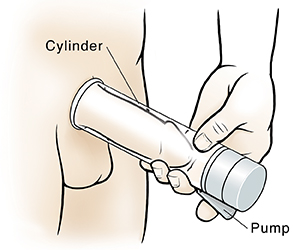
You slip a tube over your penis. A simple pump then creates a vacuum that pulls blood into your penis. This causes an erection. You then put a tension ring around the base of your penis to hold in the blood. You then remove the tube. Don't keep the tension ring on for more than 30 minutes.
-
Risks and complications may include pain in your penis or scrotum. The penis may also feel cool or change color during your erection.
Transurethral medicine
-
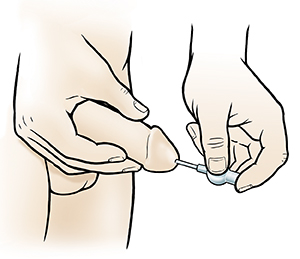
You put the end of a small applicator into your urethra to place a tiny, soft medicine pellet. The medicine is absorbed into your penis. The medicine relaxes blood vessels. Then they can fill with blood. In about 10 minutes, your penis can be hard enough for sex. To keep your erection, you may need to use a tension ring.
-
Risks and complications may include pain and irritation of your urethra. Get medical help right away if you have an erection for more than 4 hours.
Self-injections
-
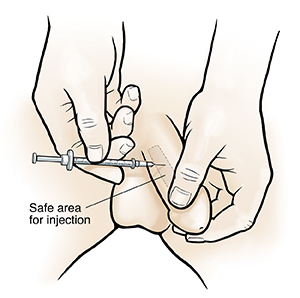
You inject a special medicine into your penis. The medicine relaxes blood vessels. Then they can fill with blood. In about 10 minutes, your penis can be hard enough for sex. A tension ring isn't needed to keep your erection. Your healthcare provider can explain the injection process to you.
-
Risks and complications may include pain, bleeding, bruising, or scarring. Get medical help right away if you have an erection for more than 4 hours.
Tension ring
-
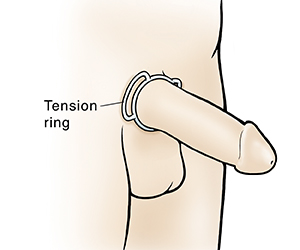
A tension ring is often used along with another type of treatment. Once enough blood has flowed into your penis to cause an erection, the tension ring will stop the blood from flowing out again. This keeps the erection. Don't keep the ring on for more than 30 minutes. A tension ring is also called a constriction ring or venous flow controller.
-
Risks and complications may include pinched, bruised, or irritated skin. If you have an allergic reaction to latex rings, try a silicone ring.
Online Medical Reviewer: Marc Greenstein MD
Online Medical Reviewer: Raymond Kent Turley BSN MSN RN
Online Medical Reviewer: Rita Sather RN
Date Last Reviewed: 03/01/2024
© 2000-2026 The StayWell Company, LLC. All rights reserved. This information is not intended as a substitute for professional medical care. Always follow your healthcare professional's instructions.