You can help prevent illness and injury by reading the warning label for each hazardous substance you use. If you have questions about the warning label, check the SDS. The SDS has detailed information about the hazardous substance you're using. The image shown here is an example of a National Fire Protection Association (NFPA) label, and its numbers and symbols are explained.
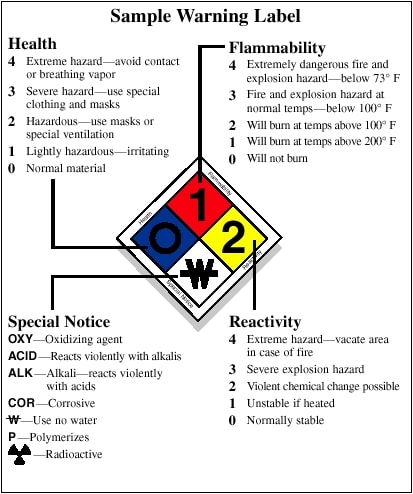
NFPA 704 warning labels
You may see a warning label on a container or on a box of containers. One example is a case of chemical jugs. These labels provide the most important information you need to know about the substance you are handling.
The number system is based on the NFPA 704 rating:
- Hazard ratings range from 0 to 4, with 4 being the most hazardous. These are used for three categories: health (blue), flammability (red), and instability (yellow). For example, if the substance has a low risk for flammability, a “1” may appear in the flammability section.
- The special hazard category shows other important hazards to be aware of. These include OX (oxidizers), W (water reactives), and SA (simple asphyxiant gases, such as nitrogen or helium).
Online Medical Reviewer: Eric Perez MD
Online Medical Reviewer: Marianne Fraser MSN RN
Online Medical Reviewer: Raymond Kent Turley BSN MSN RN
Date Last Reviewed: 12/01/2022
© 2000-2026 The StayWell Company, LLC. All rights reserved. This information is not intended as a substitute for professional medical care. Always follow your healthcare professional's instructions.